Photo by Pixabay
Outdoor branding presents challenges that indoor applications never face. Exposure to weather, UV light, abrasion, and handling quickly reveals weaknesses in materials and production choices. Waterproof outdoor stickers address these challenges by offering a durable, flexible branding solution that survives real-world conditions. When produced correctly, they become long-term brand assets rather than short-lived promotional tools.
Why Waterproof Stickers Matter for Outdoor Branding
Waterproof outdoor stickers are used across a wide range of applications, from storefront windows and vehicles to equipment, packaging, and public installations. Their value lies in persistence. A sticker that remains intact and legible for months or years delivers repeated brand exposure at a low cost per impression. This makes durability the primary performance metric, not initial appearance alone.
Material choice is the foundation of effective outdoor stickers. Vinyl is the most common substrate because it resists moisture, tearing, and temperature fluctuations. Unlike paper-based stickers, vinyl does not absorb water, which prevents swelling, peeling, and ink bleed. For outdoor branding, material durability determines whether the sticker supports or undermines brand credibility.
Adhesive quality is equally important. Outdoor stickers require adhesives designed to bond securely to varied surfaces such as metal, glass, plastic, and painted finishes. Weak adhesives lead to edge lifting and premature failure. Strong, pressure-sensitive adhesives ensure that waterproof outdoor stickers remain in place despite rain, heat, and vibration. Adhesive selection should always match the intended surface and duration of use.
Print method influences both appearance and longevity. Eco-solvent, latex, and UV printing are commonly used for outdoor stickers because they produce water-resistant results. When paired with proper curing and lamination, these methods protect ink from fading and abrasion. Lamination adds a protective layer that shields the print from UV exposure, scratches, and chemicals. For outdoor branding, lamination is not an upgrade. It is a requirement.
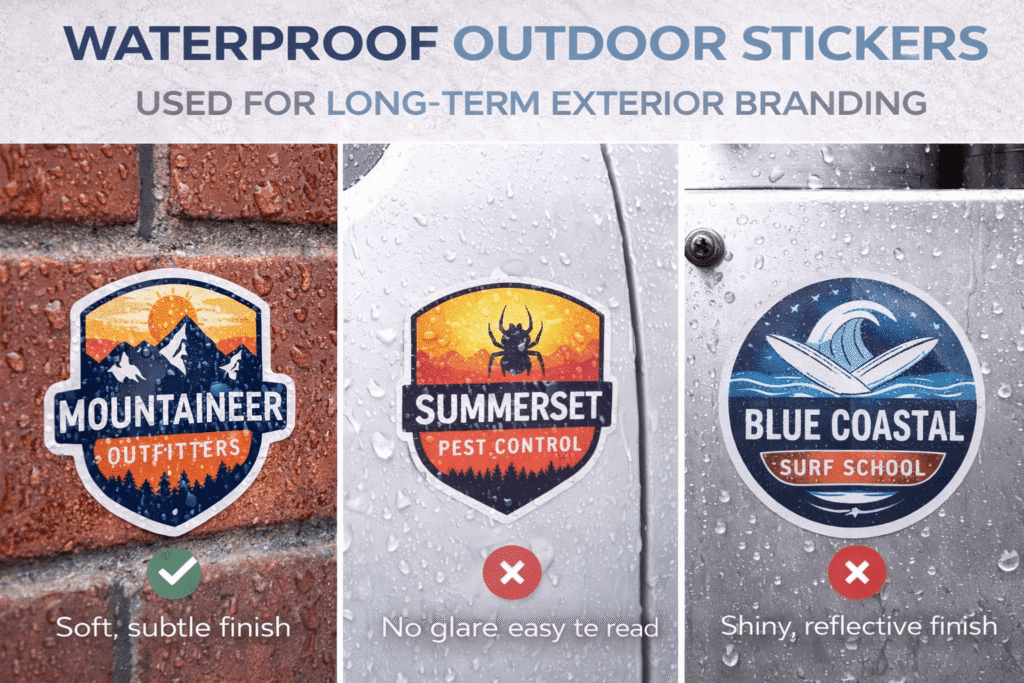
Finish choice affects performance and perception. Gloss finishes enhance colour vibrancy and visibility, making them effective for high-impact branding. Matte finishes reduce glare and fingerprints, which can improve readability in bright conditions. The decision should be guided by placement and viewing environment rather than aesthetic preference alone.
Shape and size also play a role in durability. Stickers with rounded corners resist lifting better than sharp corners, especially in outdoor conditions. Larger stickers may attract more attention but are also exposed to more stress. Designing within practical size limits improves longevity and reduces failure points.
Application context should guide design decisions. Outdoor stickers are often viewed at a distance or in motion. Clear typography, strong contrast, and simple layouts improve legibility. Overly detailed designs may look impressive up close but lose impact outdoors. Waterproof outdoor stickers perform best when the message is concise and visually direct.
Vehicles are a common use case for outdoor stickers. Decals applied to cars, vans, or trailers must withstand wind, rain, washing, and sun exposure. In this context, flexibility is critical. Vinyl stickers must conform to curves without cracking or lifting. Proper installation is just as important as material choice. Poor application undermines even the highest-quality sticker.
Equipment and asset branding is another strategic application. Waterproof outdoor stickers are often used to label tools, machinery, bins, or containers. These stickers support asset identification and brand presence simultaneously. Durability is essential because these items are handled frequently and exposed to harsh conditions. A sticker that fails early reflects poorly on operational standards.
Outdoor event branding also benefits from waterproof stickers. Temporary signage, wayfinding, and promotional placements rely on stickers that can endure short-term exposure without failure. Even when used temporarily, durability matters. A sticker peeling halfway through an event damages professionalism and visual consistency.
Sustainability considerations are increasingly relevant. While waterproof stickers are typically synthetic, longevity itself is a sustainability factor. A sticker that remains in use longer reduces replacement frequency and waste. Selecting durable materials aligns with responsible branding by prioritising lifespan over disposability.
Testing should never be skipped. Outdoor conditions vary widely depending on climate and placement. Sample testing allows brands to evaluate adhesion, colour stability, and finish performance before full deployment. This step reduces risk and ensures that waterproof outdoor stickers perform as expected.
Cost should be evaluated over time rather than per unit. While high-quality outdoor stickers may cost more upfront, their extended lifespan lowers total cost of ownership. Replacing failed stickers repeatedly costs more than investing in durability from the start. For long-term branding, quality is always the more economical choice.
Consistency across batches is critical for brands running ongoing outdoor campaigns. Colour accuracy, material specification, and finish must remain stable across reorders. This requires documented standards and reliable production partners. Inconsistent stickers undermine brand recognition and professionalism.
Working with experienced print specialists improves outcomes significantly. Strategic guidance ensures that material, adhesive, print method, and finish are aligned with real-world use. This is where collaboration with Kawaii Labs Corporate supports informed decisions by focusing on durability, placement, and long-term brand impact rather than short-term savings.
Planning timelines also affect quality. Rushed production increases the likelihood of shortcuts, such as skipping lamination or using unsuitable materials. Allowing time for proofing and testing protects brand reputation and reduces rework.
Ultimately, waterproof outdoor stickers succeed when they are treated as infrastructure rather than decoration. They must withstand environment, handling, and time. When designed and produced with intention, they deliver continuous visibility in places where other branding cannot.
For outdoor branding, reliability is the message. Waterproof outdoor stickers that stay intact communicate professionalism, consistency, and attention to detail. In environments where conditions are unpredictable, durability becomes the strongest brand statement a sticker can make.