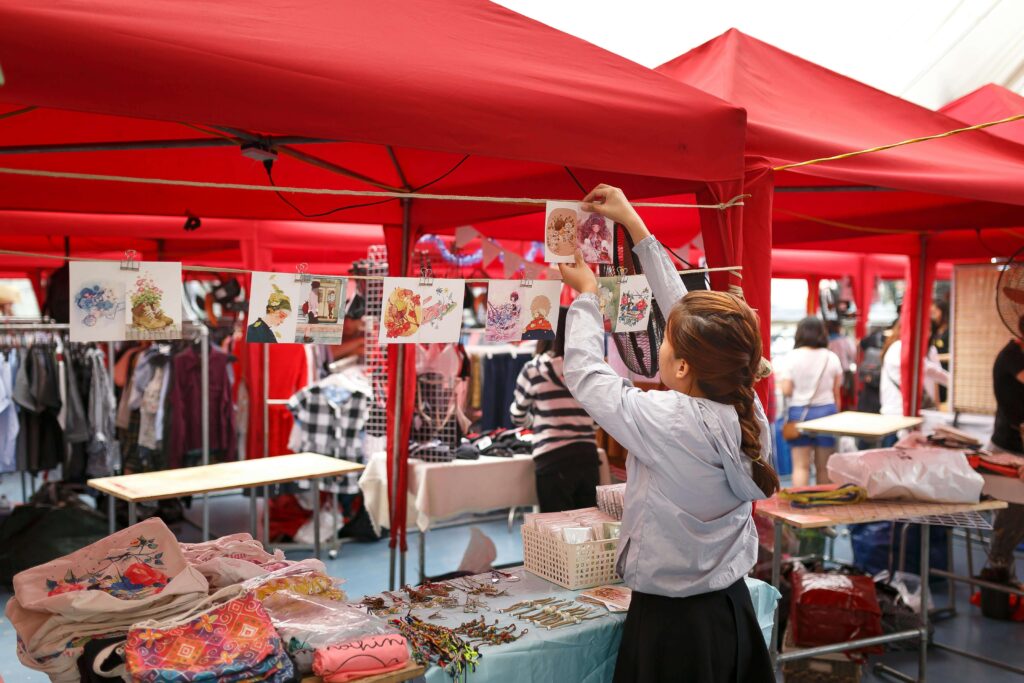
Photo by Quang Nguyen Vinh
Event merchandise fails when it is treated as a giveaway instead of a tool. Guests do not attend events to collect objects. They attend for value, connection, and experience. Merchandise only works when it extends that experience beyond the event itself. Event merchandise design should therefore focus on relevance, usefulness, and longevity rather than novelty.
The most important question to ask is simple: would someone use this if the logo were removed. If the answer is no, the item is unlikely to survive beyond the event. Guests are selective about what they carry home and even more selective about what they keep. Event merchandise design must earn its place in daily life.
Usefulness is the strongest predictor of retention. Items that solve small, recurring problems perform best. Think of tools that fit naturally into work, travel, or daily routines. The more frequently an item is used, the more quietly and effectively it reinforces brand presence.
Budget-Friendly Event Merchandise That Still Feels Premium
Quality sets the baseline for trust. Cheap merchandise communicates disposability. Guests may accept it politely, but they rarely keep it. A smaller quantity of well-made items outperforms large volumes of low-quality stock. Event merchandise design should prioritise durability over reach.
Context matters. Merchandise should make sense for the type of event and the audience attending. A corporate conference, a product launch, and a community activation all attract different expectations. Designing one-size-fits-all merchandise usually results in generic outcomes. Event merchandise design works best when it responds to why people are there.
Branding restraint is essential. Over-branded items feel promotional and limit where they can be used. Subtle branding increases adoption. A discreet logo, a considered colour choice, or a minimal mark allows items to blend into professional or personal environments. Event merchandise design should aim for integration, not dominance.
Form factor influences behaviour. Bulky items are inconvenient to carry and store. Lightweight, compact items are more likely to leave the venue with guests. If an item is awkward to transport, it is often discarded before the event ends. Event merchandise design should respect physical constraints.
Packaging should be minimal and functional. Excess packaging adds cost and waste without improving perceived value. Simple, tidy presentation signals efficiency and respect for the guest’s time. Merchandise should be easy to take, not something that requires explanation.
Longevity should guide selection. Items that last weeks or months deliver ongoing exposure. Short-lived items create a brief impression and then disappear. Event merchandise design should consider cost per month of use rather than cost per unit.
Personalisation should be purposeful. Adding names or dates increases complexity and limits reuse. In many cases, a campaign-specific message or colour palette achieves relevance without sacrificing scalability. Event merchandise design should balance relevance with operational practicality.
Avoid trend chasing. Items chosen because they are popular this season often date quickly. Timeless designs age better and remain usable longer. Event merchandise design should favour neutral aesthetics that survive changing tastes.
Sustainability influences perception increasingly. Disposable items conflict with responsible positioning. Reusable, durable merchandise aligns better with modern expectations. Sustainability is communicated through design choices, not slogans. Event merchandise design should reflect this through material and longevity.
Distribution timing affects reception. Handing out merchandise too early can feel transactional. Providing it at meaningful moments, such as after a session or during closing, ties the item to experience rather than attendance. Event merchandise design should consider when the item enters the guest’s hands.
Relevance to the event theme improves retention. Merchandise that reflects the content, purpose, or outcome of the event feels intentional. Generic items weaken association. Event merchandise design should reinforce what the event stood for.
Storage and logistics should not be ignored. Merchandise must arrive on time, in good condition, and in manageable quantities. Over-ordering creates waste. Under-ordering creates frustration. Event merchandise design should align with realistic attendance data.
Consistency across merchandise builds recognition. A small, cohesive set of items performs better than a scattered assortment. Guests are more likely to keep items that feel part of a considered system. Event merchandise design benefits from focus rather than variety.
Measurement should be behavioural. Are items visible weeks later. Are they used in meetings or daily routines. Feedback and observation reveal what works. Event merchandise design should evolve based on evidence, not assumptions.
Budget discipline improves outcomes. Spending more does not guarantee success. Spending intentionally does. Allocating budget to quality and relevance produces better results than spreading it thinly. Event merchandise design should be evaluated on impact, not volume.
Avoid forced branding messages. Merchandise should not attempt to explain the brand. That work is done through experience and conversation. The item’s role is to remind, not persuade. Event merchandise design succeeds when it supports memory quietly.
Integration with other event materials strengthens impact. Merchandise should align visually with signage, print, and digital assets. This consistency reinforces recognition. Disconnected merchandise feels like an afterthought.
Staff involvement matters. Teams distributing merchandise should understand why each item exists. When staff can explain purpose, guests perceive greater value. Event merchandise design works best when it is part of the overall event narrative.
Testing before large runs reduces risk. Producing small batches for trial events reveals what guests actually keep and use. This prevents costly mistakes at scale.
Working with experienced print and branding partners improves outcomes significantly. Strategic guidance helps align item selection, branding restraint, and production quality with event goals. Collaboration with Kawaii Labs Corporate supports this process by translating event objectives into merchandise that guests genuinely value.
Ultimately, guests do not want more stuff. They want fewer, better things. Event merchandise design that respects this reality delivers stronger retention and better brand perception.
When merchandise feels useful, well-made, and appropriate, it becomes part of the guest’s routine. That ongoing presence is the real return.
Designing event merchandise that guests actually want is not about standing out on the day. It is about staying relevant long after the event ends.