
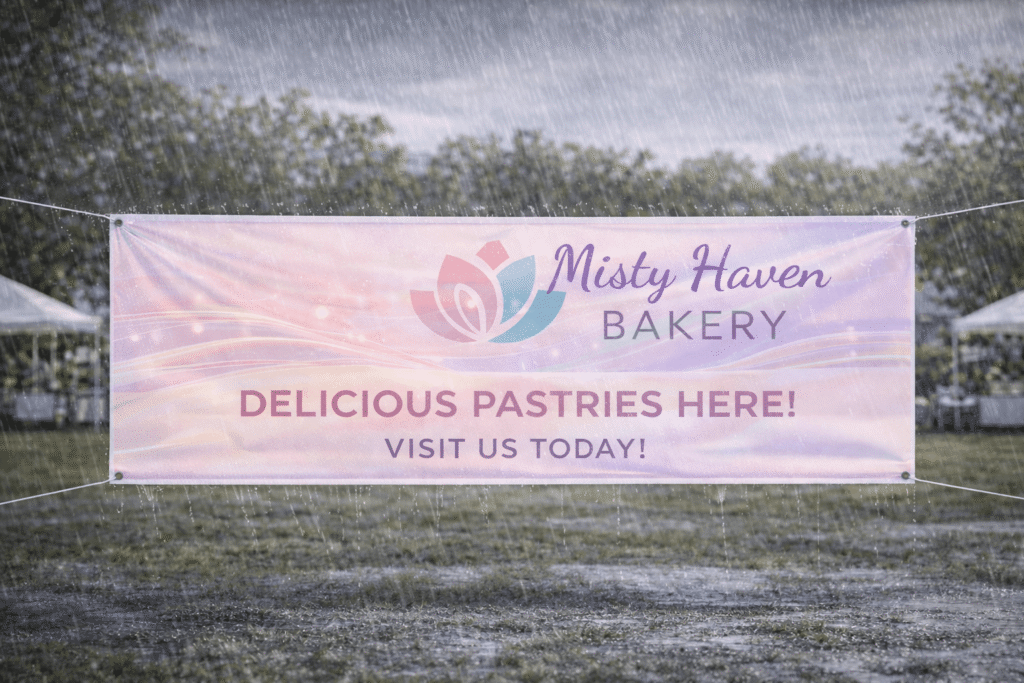
Photo by Kawaii Labs
Weather is one of the most underestimated factors in banner performance. Many banners fail not because of poor design, but because the material, ink, or finishing was not suited to the environment. Weather-resistant banner printing is about anticipating real conditions rather than hoping for ideal ones. When weather is ignored, banners fade, tear, curl, or fail mid-event, damaging brand perception in the process.
Choosing the Right Banner for Different Weather Conditions
The first environmental factor to consider is sunlight. UV exposure causes colour fading and material degradation over time. Banners placed outdoors, even temporarily, are exposed to direct sun for hours at a time. Inks not rated for UV resistance lose vibrancy quickly. Weather-resistant banner printing relies on inks and substrates designed to maintain colour integrity under prolonged exposure.
Material choice plays a central role in sun performance. PVC vinyl performs well outdoors when paired with appropriate inks. Fabric banners can look premium but often fade faster if not printed and treated correctly. Weather-resistant banner printing should always specify UV-stable inks regardless of material.
Heat interacts with sunlight in subtle ways. Dark colours absorb more heat, which increases stress on materials. Excessive heat can cause warping, stretching, or adhesive failure. Banners installed against metal fences or walls may experience amplified heat. Material selection and colour discipline reduce these risks.
Wind is often the most destructive factor. Banners act like sails when exposed to gusts. Solid banners placed in windy environments experience constant tension, especially at fixing points. Weather-resistant banner printing must account for wind load through material choice and finishing methods.
Mesh banners are specifically designed for wind-prone environments. Their perforated structure allows air to pass through, reducing stress on fixings. While they slightly reduce image density, they significantly improve longevity in exposed locations. Weather-resistant banner printing often favours mesh when wind is unpredictable.
Finishing matters as much as material. Reinforced hems, welded edges, and strong eyelets distribute tension more evenly. Poor finishing causes banners to tear at stress points even when the material itself is durable. Banner printing includes specifying appropriate finishing for the environment, not treating it as an afterthought.
Rain and moisture introduce different challenges. Water exposure affects both inks and substrates. Some materials absorb moisture, leading to sagging or mildew. Others repel water effectively. Weather-resistant banner printing requires materials that maintain structure and appearance when wet.
PVC banners generally perform well in rain, provided inks are waterproof and edges are sealed. Fabric banners require proper drying before storage to prevent mould. If banners are packed away damp, deterioration accelerates regardless of print quality.
Humidity also affects performance, particularly in coastal or tropical regions. High humidity softens some materials and weakens adhesives. Banners intended for humid environments should use substrates proven to maintain stability under moisture exposure. Weather-resistant banner printing should be region-aware rather than generic.
Cold temperatures create their own risks. Some vinyl materials become brittle in low temperatures, increasing the risk of cracking during installation or wind movement. Banners installed in winter or cold climates require materials rated for flexibility at lower temperatures. Weather-resistant banner printing must consider seasonal extremes, not just average conditions.
Rapid changes increase stress. Banners may experience sun, wind, and rain within the same day. Materials that perform well in one condition but fail in another create reliability issues. Choosing balanced, multi-condition materials improves consistency and reduces failure risk.
Dust and debris are often overlooked. Outdoor environments introduce abrasive particles that scratch surfaces and dull print over time. Matte finishes often mask wear better than gloss. Weather-resistant banner printing considers finish choice as part of durability, not just aesthetics.
Installation location influences weather exposure. Banners mounted between structures experience different wind patterns than those on open fences. Elevated banners receive more wind stress than ground-level signs. Weather-resistant banner printing should align with placement strategy.
Orientation affects exposure. Horizontal banners catch more wind. Vertical banners often perform better in gusty conditions. Design and material decisions should align with orientation to reduce strain.
Duration of exposure is critical. Short-term events can tolerate lighter materials. Long-term outdoor signage requires robust substrates and finishes. Weather-resistant banner printing should be specified based on how long the banner will be displayed, not just where.
Reusability adds another layer. Banners intended for repeated outdoor use must survive installation, removal, transport, and storage. Materials that degrade after one exposure create hidden costs. Weather-resistant banner printing focuses on total lifecycle performance.
Storage conditions matter after weather exposure. Banners should be cleaned and dried before storage. Rolling banners tightly while damp traps moisture and accelerates degradation. Longevity depends on both production and handling.
Ink technology influences weather performance significantly. Solvent, eco-solvent, latex, and UV inks each offer different durability profiles. Choosing the correct ink for outdoor conditions is as important as choosing the right material. Weather-resistant banner printing aligns ink choice with expected exposure.
Colour choices affect perceived longevity. Very light colours may show dirt more quickly. Very dark colours may show fading more clearly. Balanced colour palettes often age better outdoors.
Cost decisions should consider replacement risk. Cheaper banners that fail early often cost more once reprinting and downtime are considered. Weather-resistant banner printing prioritises reliability over minimal upfront spend.
Safety should never be ignored. Banners that tear loose in wind create hazards. Selecting appropriate materials and fixings reduces risk and protects brand reputation.
Testing banners in real conditions provides valuable insight. Small sample installations reveal weaknesses before large-scale deployment. This reduces costly mistakes.
Consistency across outdoor assets improves predictability. Using the same weather-resistant specifications simplifies planning and ensures consistent results across campaigns.
Working with experienced print partners improves outcomes significantly. Strategic guidance helps brands select materials, inks, and finishing methods suited to local weather realities. Collaboration with Kawaii Labs Corporate supports this process by aligning weather-resistant banner printing choices with environment, duration, and brand requirements.
Ultimately, weather does not compromise banners by accident. Failure occurs when conditions are ignored. Banners succeed outdoors when they are designed, printed, and finished with environment in mind.
Weather-resistant banner printing protects visibility, credibility, and investment. When banners withstand sun, wind, rain, and time, they continue to communicate without interruption.
Outdoor signage is judged under pressure. Planning for weather ensures your banner performs when conditions are at their worst, not just when they are convenient.


