Photo by Pexels
Choosing the right branding method for apparel is a strategic decision that affects durability, comfort, brand perception, and return on investment. Sublimation vs embroidery is one of the most common comparisons brands face when producing corporate wear, sports apparel, or promotional clothing. Both methods are widely used, but they serve different purposes and perform differently in real-world conditions.
Understanding the pros and cons of each method helps brands avoid mismatched applications that lead to wasted spend or poor wearer adoption. The right choice depends less on trend and more on how the garment will be used, washed, and perceived over time.
Understanding Sublimation and Embroidery Basics
Sublimation is a print method where dye is infused directly into polyester fibres using heat. The result is permanent colour that becomes part of the fabric. Embroidery, by contrast, involves stitching thread into the garment surface to create a raised, textured design. Each method creates a very different outcome in look, feel, and performance.
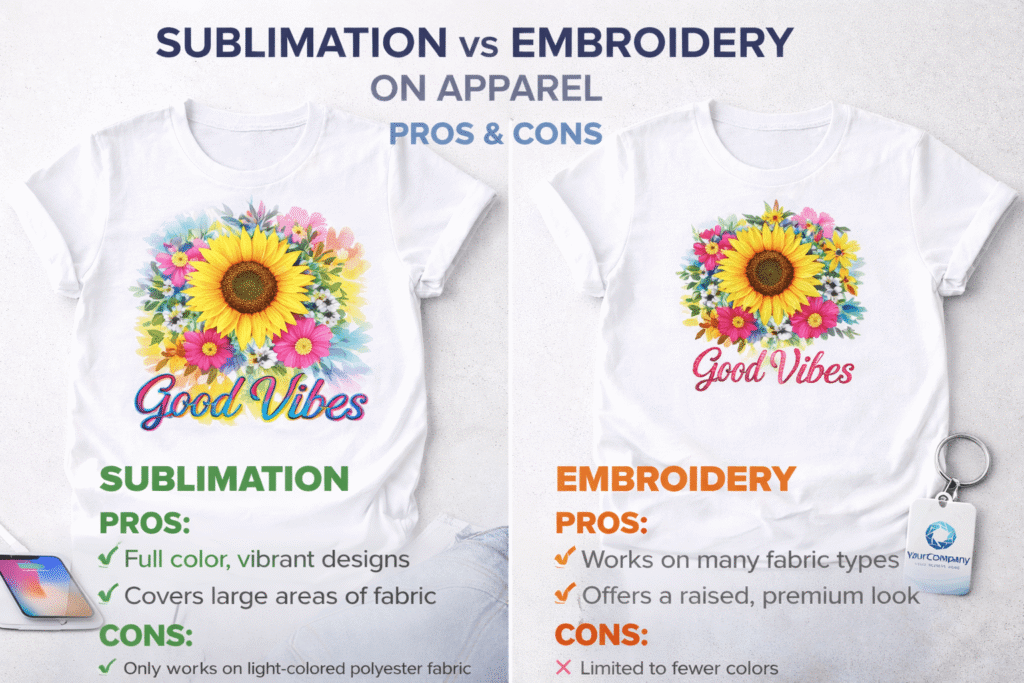
One of the strongest advantages of sublimation is comfort. Because the dye integrates into the fabric, there is no added layer or texture. The garment remains lightweight, breathable, and flexible. This makes sublimation ideal for sportswear, activewear, and garments worn for long periods. Wearers often forget the print is even there, which increases comfort and long-term use.
Embroidery introduces texture and weight. While this can enhance perceived quality in some contexts, it can also reduce comfort, especially on lightweight garments. Stitched areas do not stretch in the same way as fabric, which can cause pulling or stiffness. For garments worn during physical activity, this can be a drawback.
Durability is often cited as embroidery’s strongest advantage. Properly executed embroidery withstands frequent washing and heavy use. The stitched design remains visible even as the garment ages. This makes embroidery well suited to workwear, uniforms, and garments exposed to rough conditions.
However, sublimation also offers excellent durability when used correctly. Sublimated designs do not crack, peel, or fade because there is no surface layer to degrade. On polyester garments, sublimation often outlasts the fabric itself. The key limitation is fabric compatibility. Sublimation works best on light-coloured polyester. It is not suitable for cotton or dark fabrics without coatings.
Visual flexibility is another major point of difference. Sublimation supports full-colour, high-detail designs, gradients, and all-over prints without added cost per colour. This allows brands to execute complex visual systems consistently. Embroidery is limited by thread colour, stitch density, and design complexity. Fine details and gradients are difficult or impossible to reproduce accurately.
Embroidery, however, offers a premium, traditional aesthetic that many corporate brands value. The raised texture communicates formality and longevity. For logos on polos, jackets, and uniforms, embroidery often aligns better with conservative brand positioning. Sublimation tends to feel more modern and expressive.
Scalability also differs between the two methods. Sublimation scales efficiently for medium to large runs once designs and profiles are approved. Repeat orders remain consistent, making it suitable for ongoing programmes. Embroidery requires digitising designs and machine time per garment, which can increase costs as complexity grows.
Placement flexibility is another factor. Sublimation supports all-over and edge-to-edge printing. Embroidery is better suited to contained areas such as chest logos, sleeves, or caps. Large embroidered areas add weight and cost, while large sublimated areas remain lightweight.
Cost comparison depends on context. Embroidery often has a higher setup cost due to digitising, but small, simple logos can be cost-effective over time. Sublimation may have a higher garment cost due to fabric requirements, but it reduces limitations on design complexity. Evaluating cost over the garment’s lifespan provides a more accurate comparison than upfront pricing alone.
Brand perception is shaped by execution quality rather than method alone. Poor embroidery with loose stitching reflects badly on a brand, just as poorly calibrated sublimation does. Quality control matters more than method choice. This is why working with experienced production partners is critical. Strategic guidance ensures that sublimation vs embroidery decisions align with garment use, audience expectations, and brand positioning. Partners like Kawaii Labs Corporate help brands avoid common mismatches that compromise results.
There are also cases where combining both methods makes sense. Some brands use embroidery for primary logos and sublimation for patterns or secondary elements. This hybrid approach balances texture and visual flexibility while maintaining brand hierarchy.
Ultimately, the choice between sublimation vs embroidery depends on purpose. Sublimation excels in performance-driven, high-visual-impact applications where comfort and design freedom matter. Embroidery excels in traditional, durability-focused contexts where texture and formality support brand image.
There is no universal winner. The winning method is the one that aligns with how the apparel will be worn, how often it will be washed, and what the brand needs to communicate. When branding decisions are guided by use case rather than habit, apparel becomes a long-term asset rather than a short-term solution.