
Photo by Kawaii Labs
Franchise growth depends on repetition done correctly. Every new location must look, feel, and function like the brand customers already recognise. Signage is one of the most visible signals of this consistency. Franchise signage kits are not just collections of signs. They are systems designed to protect brand integrity while enabling rapid, controlled expansion.
The Importance of Signage Kits in Franchise Success
Without a defined signage kit, franchise rollouts quickly become inconsistent. Individual franchisees make local decisions, suppliers vary, and visual standards drift. Over time, the brand fragments. Franchise signage kits prevent this by defining exactly what gets printed, where it goes, and how it is applied.
The primary benefit of signage kits is standardisation. Each kit includes pre-approved signage elements that reflect the brand’s visual identity, tone, and hierarchy. This removes guesswork at local level and ensures every site launches with the same core visual language.
Speed is critical during rollouts. New locations often operate under tight timelines. Signage kits reduce delays by packaging everything needed into a single, repeatable solution. Instead of sourcing signage piece by piece, franchisees receive a complete, ready-to-install set.
Consistency does not mean rigidity. Well-designed franchise signage kits balance standard elements with controlled flexibility. Core signage remains fixed, while optional or localised elements can be added within defined parameters. This allows adaptation without compromising brand standards.
Operational simplicity is another key advantage. Franchisees are rarely branding experts. Clear signage kits reduce cognitive load by providing instructions, placement guides, and predefined specifications. This improves installation accuracy and reduces costly errors.
Cost control improves through repetition. Producing the same signage formats repeatedly lowers unit costs and simplifies budgeting. Signage kits allow brands to forecast expenses accurately and avoid unpredictable local sourcing costs.
Quality control becomes easier when signage is standardised. Approved materials, finishes, and production methods ensure durability and professional appearance across locations. This protects brand perception, especially during early customer interactions.
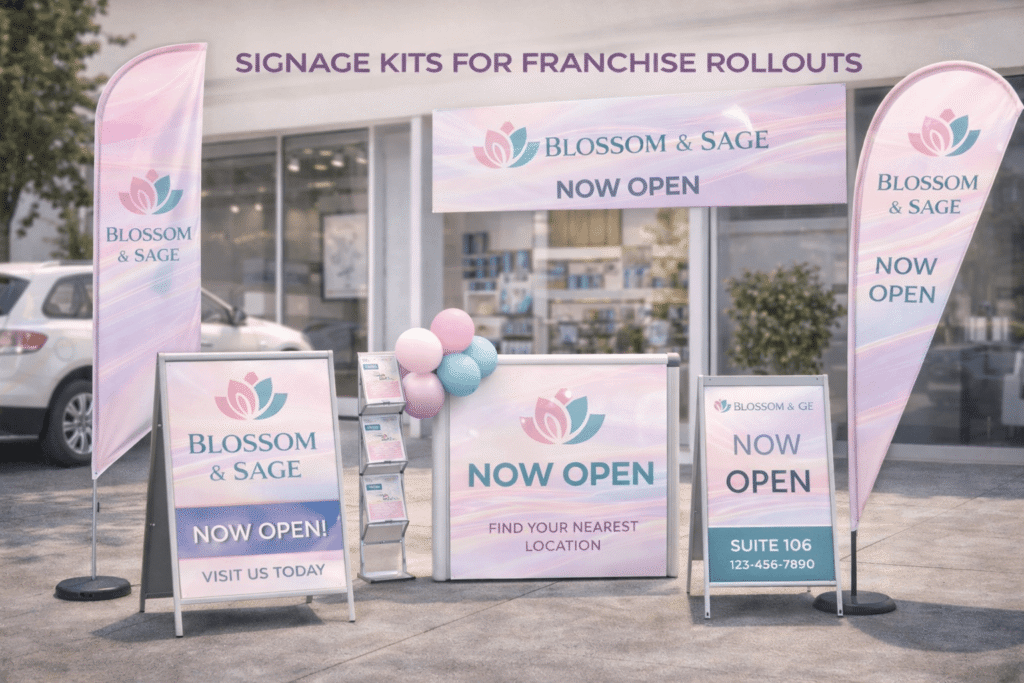
Signage kits typically include exterior signage, interior branding, wayfinding, compliance signs, and promotional placeholders. Each category serves a distinct role. Clear separation ensures that functional signage does not compete visually with brand messaging.
Exterior signage is often the most regulated element. Franchise signage kits account for size limits, placement rules, and material requirements. Where local regulations vary, kits may include approved alternatives rather than leaving decisions to individual franchisees.
Interior signage supports both customer experience and operations. Menu boards, service lists, directional signs, and brand statements should follow consistent layout and hierarchy. Signage kits ensure customers receive the same experience regardless of location.
Wayfinding is especially important in larger franchise environments. Clear, standardised navigation reduces confusion and improves flow. Consistent symbols and terminology reinforce familiarity across sites.
Compliance signage should never be improvised. Health, safety, and legal requirements must be met consistently. Franchise signage kits include compliant templates that can be adapted only where regulations require local variation.
Modularity strengthens rollout efficiency. Kits designed with modular components allow partial updates without full replacement. This is especially useful during rebrands or phased rollouts. Signage kits that support updates reduce long-term costs.
Installation guidance is often overlooked. Clear diagrams, placement rules, and height guidelines ensure signage is positioned correctly. Poor placement undermines even the best design. Franchise signage kits should include practical installation support.
Training and onboarding benefit from signage consistency. Staff moving between locations encounter familiar layouts and visuals. This reduces training time and improves operational alignment.
Supply chain simplification is another advantage. Centralised production reduces variability and simplifies logistics. Signage kits streamline ordering, delivery, and replacement processes.
Replacement and expansion become predictable. When a sign is damaged or a new location opens, the same kit can be reordered. This repeatability protects visual standards over time.
Sustainability considerations are increasingly relevant. Modular kits reduce waste by allowing selective replacement. Durable materials extend lifespan. Signage kits support responsible scaling when designed thoughtfully.
Brand evolution must be planned for. Successful franchises grow and adapt. Signage kits should allow future updates without forcing complete replacement. Building in flexibility from the start prevents disruption later.
Governance matters. Clear rules around signage usage, modification, and approval protect consistency. Signage kits should be backed by documented standards, not informal expectations.
Local marketing still has a place. Promotional signage should be clearly separated from core branding. Signage kits often include designated areas or templates for local campaigns without affecting permanent signage.
Auditing becomes easier with standard kits. Brand teams can assess compliance quickly when signage elements are known and consistent. Deviations are easier to spot and correct.
Franchise signage kits also protect franchisees. Clear standards reduce disputes about what is required and what is optional. This transparency supports healthier franchise relationships.
Working with experienced print and branding partners improves outcomes significantly. Strategic guidance helps brands design signage kits that balance consistency, flexibility, and operational reality. Collaboration with Kawaii Labs Corporate supports this process by translating brand systems into scalable, repeatable signage solutions.
Planning signage kits early prevents chaos later. Retrofitting consistency after multiple locations are open is costly and disruptive. Franchise signage kits work best when they are part of the rollout strategy from day one.
Ultimately, franchise success depends on repetition without erosion. Every new location should reinforce, not dilute, the brand.
Franchise signage kits make that possible. They turn brand standards into physical reality at scale, ensuring that growth strengthens recognition rather than weakening it.
When signage is consistent, clear, and professionally executed, customers feel confident. That confidence is the foundation on which successful franchise networks are built.


