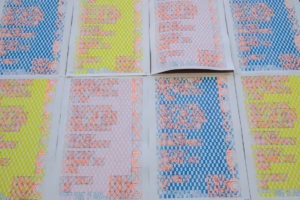

Photo by Maria Tyutina
Choosing the right print method has a direct impact on brand perception, product lifespan, and overall return on investment. Full-colour printing vs heat transfer is a comparison many businesses face when planning branded merchandise, promotional products, or corporate gifts. While both methods have legitimate applications, they perform very differently depending on context, volume, and intended use.
Understanding the strengths and limitations of each method helps brands avoid short-term decisions that compromise long-term visibility. The question is not which method is cheaper upfront, but which one delivers sustained value once the product enters real-world use.
Understanding Full-Colour Printing and Heat Transfer
Full-colour printing is an umbrella term that includes methods such as digital direct printing, UV printing, screen printing, and sublimation. What these methods share is that the ink is applied directly to the product surface or embedded into it. This direct application generally results in better colour accuracy, stronger adhesion, and higher durability.
Heat transfer printing, by contrast, relies on applying a pre-printed design to a product using heat and pressure. The design is transferred from a carrier sheet onto the surface. This method is often used for short runs, quick turnarounds, or highly variable designs.
Durability is one of the most important differentiators in the full-colour printing vs heat transfer debate. Full-colour printing methods typically outperform heat transfer when it comes to longevity. Because the ink is either cured directly onto the surface or infused into the material, it is less likely to crack, peel, or fade over time.
Heat transfer prints sit on top of the product surface. Over repeated use, washing, or exposure to heat and friction, these transfers are more prone to wear. This makes heat transfer less suitable for items intended for long-term use, such as corporate gifts, employee merchandise, or products meant to represent brand quality.
From a visual standpoint, full-colour printing offers superior consistency across larger production runs. Colour profiles can be calibrated, and results remain stable across batches. This is critical for brands that rely on colour accuracy as part of their identity. Inconsistent colour reproduction undermines professionalism.
Heat transfer can deliver sharp visuals initially, but consistency becomes harder to maintain at scale. Variations in pressure, temperature, and placement can lead to uneven results. This is a key consideration when comparing full-colour printing vs heat transfer for brand-critical items.
Scalability also favours full-colour printing in most professional contexts. Once a setup is complete, full-colour methods scale efficiently for medium to large runs. This reduces per-unit cost over time and supports repeat ordering. Heat transfer, while flexible, becomes labour-intensive at scale. Each item requires individual application, increasing the risk of inconsistency and production delays.
That said, heat transfer does have strategic use cases. It performs well for small batches, prototypes, or campaigns requiring frequent design changes. For short-term events or limited internal use, heat transfer can be practical. However, this advantage disappears when longevity and perception matter.
Another critical factor is product feel. Full-colour printing often integrates seamlessly with the product surface. Sublimation, for example, leaves no texture at all. This improves user experience and reduces resistance to everyday use. Heat transfer prints add a noticeable layer, which can feel stiff or artificial depending on the material. This can discourage continued use, especially on items handled frequently.
Cost is often cited as a reason to choose heat transfer, but this comparison is frequently misleading. While heat transfer may have a lower initial cost for very small runs, the cost per impression over time is higher if the product fails early. Full-colour printing delivers better long-term value because the product remains usable and visible for longer.
In corporate and promotional contexts, perceived quality matters as much as functionality. Products that show wear quickly reflect poorly on the brand. This is why many professional print strategies favour full-colour printing despite a higher upfront investment. The brand impact lasts longer.
Selecting the correct method also depends on substrate. Some materials respond better to direct printing, while others may require transfer methods. This is where technical guidance becomes essential. Strategic partners such as Kawaii Labs Corporate help brands choose print methods based on product use, audience, and expected lifespan rather than convenience.
In the comparison of full-colour printing vs heat transfer, there is no universal winner in every scenario. However, for long-term branding, repeat use, and professional perception, full-colour printing consistently outperforms heat transfer. Heat transfer remains a tactical tool for specific, limited applications.
Ultimately, the winning method is the one aligned with how the product will live in the real world. Brands that prioritise durability, consistency, and longevity will find full-colour printing to be the stronger investment. Print methods are not just production choices. They are brand decisions.