
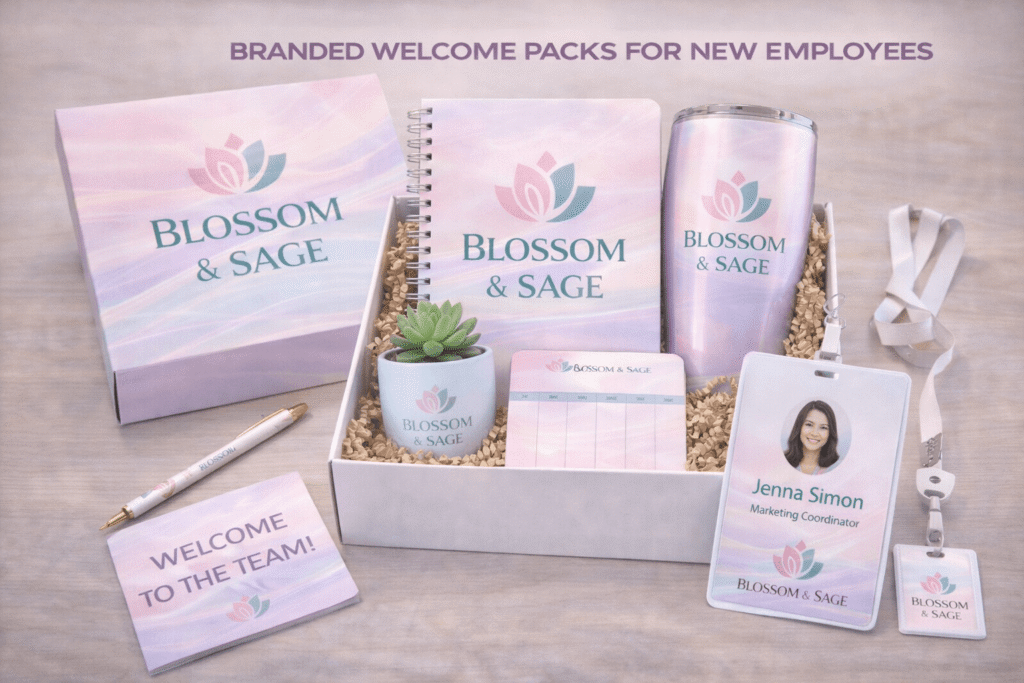
Photo by Kawaii Labs
First impressions at work are formed quickly. The first day shapes how new employees perceive the organisation, their role, and the culture they are joining. Employee welcome packs are not gifts for the sake of novelty. They are onboarding tools that communicate structure, care, and professionalism before a process is explained verbally.
Understanding the Importance of Employee Welcome Packs
A strong welcome kit reduces uncertainty. New employees arrive with questions, nerves, and incomplete context. Printed materials provide clarity when digital systems and conversations feel overwhelming. Employee welcome packs act as a physical anchor during an otherwise abstract first experience.
The purpose of a welcome kit should be defined clearly. It must support onboarding, not replace it. This means prioritising information and tools that help a new hire settle in quickly. Overloading packs with unnecessary items creates clutter and weakens impact.
Printed onboarding documents form the foundation. A concise welcome letter, a quick-start guide, or a day-one overview sets expectations immediately. These documents should be easy to read, clearly structured, and aligned with brand tone. Employee welcome packs work best when information is staged rather than exhaustive.
Branding should be restrained and intentional. Loud or overly promotional branding can feel performative. Subtle, consistent branding signals maturity and confidence. The goal is to help employees feel part of something established, not marketed to.
Stationery remains one of the most effective inclusions. Notebooks, pens, folders, or planners are practical and immediately useful. These items integrate into daily workflows and reinforce brand presence quietly. Employee welcome packs benefit from items that will be used repeatedly rather than admired once.
Quality matters more than quantity. A small number of well-made items outperforms a large assortment of cheap ones. Flimsy items undermine credibility. Durable materials signal respect for the employee and attention to detail.
Role relevance increases perceived value. While core items should remain consistent across the organisation, role-specific additions can improve usefulness. For example, technical teams may benefit from different tools than client-facing roles. Employee welcome kits can balance consistency with relevance without becoming complex.
Culture communication should be subtle. Generic value statements often go unread. Instead, practical cues about how the organisation works day to day are more effective. A short guide on meeting norms, communication expectations, or decision-making processes reinforces culture through behaviour.
Folders or presentation sleeves help organise printed materials. Loose papers create friction. Structured presentation signals order and preparation. Employee welcome packs should feel deliberate rather than assembled at the last minute.
Timing affects impact. Welcome packs should be ready on the first day, not delivered later. This signals preparation and respect. Delayed packs feel like afterthoughts. Employee welcome packs lose value when they arrive after habits have already formed.
Consistency across departments matters. When different teams receive different-quality welcome experiences, culture fragments. A standardised welcome pack supports equity and alignment. Employee welcome packs should reflect a shared baseline experience.
Internal branding benefits significantly from onboarding materials. New employees are highly receptive during early weeks. Reinforcing brand systems through print supports faster alignment. Employee welcome packs help translate abstract brand values into tangible experience.
Remote and hybrid teams still benefit from physical packs. Sending printed materials to remote employees creates a sense of inclusion and belonging. Employee welcome packs bridge the gap between digital onboarding and human connection.
Sustainability considerations are increasingly important. Excess packaging or disposable items conflict with stated values. Choosing durable, useful items reduces waste and aligns with responsible practices. Employee welcome packs should reflect what the organisation claims to value.
Personalisation should be handled carefully. Personal names on items add warmth but increase complexity. In many cases, a personalised note achieves the same effect without logistical overhead. Employee welcome packs should prioritise scalability.
Longevity influences ROI. Items that remain in use for months or years continue reinforcing brand presence. Short-lived items require replacement and reduce overall value. Employee welcome packs should be evaluated on lifespan, not initial impression.
Feedback can guide improvement. Asking new hires what they found useful reveals gaps and opportunities. Employee welcome packs should evolve based on real experience rather than assumption.
Welcome packs also support employer branding externally. Employees often share first-day experiences. A thoughtful, well-produced pack reflects positively beyond the organisation. This visibility is earned, not forced.
Operational planning improves consistency. Pre-assembled packs or defined components reduce last-minute scrambling. Predictable onboarding processes signal organisational maturity. Employee welcome packs work best when integrated into HR workflows.
Design alignment across materials strengthens impact. Typography, colour, and layout should match other internal documents. This consistency reinforces trust and professionalism. Disconnected designs weaken credibility.
Cost control improves with standardisation. Defining a core pack reduces ad hoc purchasing. Employee welcome packs should be budgeted as part of onboarding, not treated as optional extras.
Measurement of success is behavioural. Faster onboarding, fewer basic questions, and early engagement indicate effectiveness. Employee welcome kits should support smoother transitions, not just positive reactions.
Working with experienced print and branding partners improves outcomes significantly. Strategic guidance helps organisations choose materials, formats, and systems that balance usefulness, durability, and brand alignment. Collaboration with Kawaii Labs Corporate supports this process by translating onboarding goals into practical, consistent welcome packs.
Ultimately, branded welcome packs succeed because they communicate intent. They show that the organisation planned for the employee’s arrival.
Employee welcome packs are not about impressing. They are about supporting. When done well, they reduce friction, reinforce culture, and set the tone for how work gets done.
The first day should feel structured, not chaotic. Thoughtful print helps make that happen. Branded welcome packs quietly tell new employees that they belong, that standards exist, and that their time and contribution matter from day one.


