
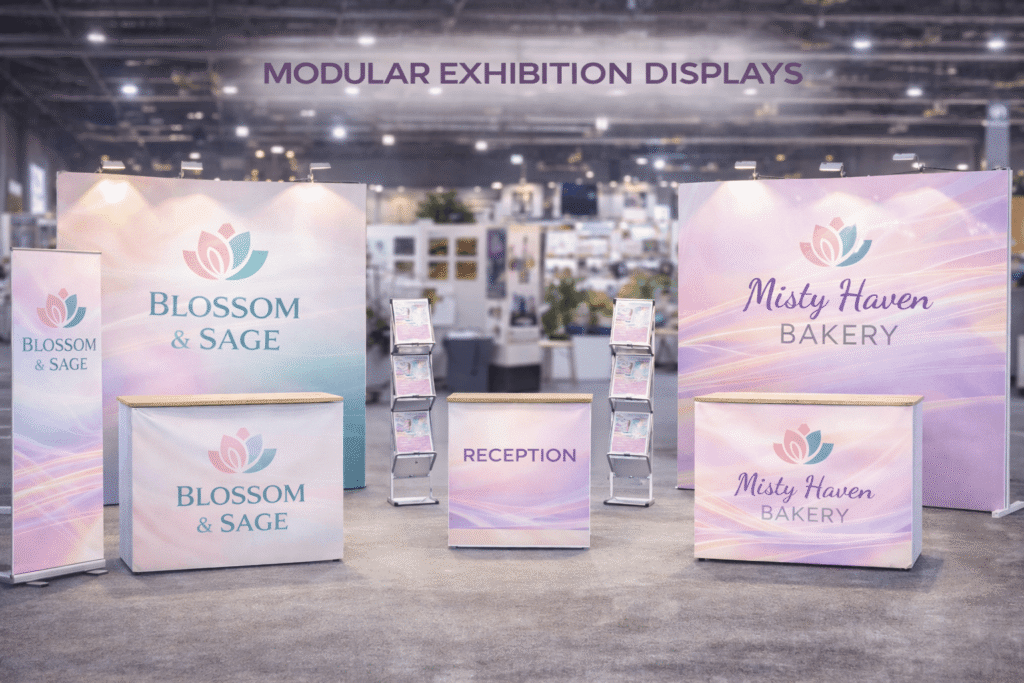
Photo by Kawaii Labs
Exhibitions and trade shows demand adaptability. Booth sizes change, venues differ, and brand priorities evolve from one event to the next. In this environment, fixed display solutions quickly become limiting. Modular exhibition displays address this challenge by offering systems that adapt, scale, and evolve without requiring complete replacement.
At their core, modular exhibition displays are built from interchangeable components. Panels, frames, counters, and graphics can be rearranged to suit different layouts. This flexibility allows brands to respond to varying floor plans and objectives while maintaining a consistent visual identity.
Exploring the Benefits of Modular Exhibition Solutions
One of the primary benefits is scalability. A single modular system can be configured for a small pop-up or expanded for a large exhibition stand. Brands no longer need separate displays for different event sizes. Modular exhibition displays grow or shrink as required, protecting investment over time.
Cost efficiency is closely tied to this scalability. While modular systems may cost more upfront than basic single-use displays, they reduce long-term expenditure. Reusing the same structure across multiple events lowers cost per use and minimises reprinting. Over time, modular exhibition displays often prove more economical than repeated one-off solutions.
Brand consistency is another significant advantage. Exhibitions are high-visibility environments where inconsistent presentation undermines credibility. Modular systems use repeatable components and layouts, ensuring the brand looks familiar across events. This consistency reinforces recognition and professionalism, even when configurations change.
Speed of setup and breakdown is critical at exhibitions. Limited access windows and strict schedules leave little room for complex assembly. Modular exhibition displays are designed for efficient setup, often requiring minimal tools. Faster assembly reduces labour costs and stress during event preparation.
Transport and storage efficiency also improve with modular systems. Components are designed to pack flat or into compact cases. This reduces transport volume and storage requirements between events. Modular exhibition displays support repeated use without excessive logistics costs.
Adaptability extends beyond size. Modular systems allow brands to update messaging without replacing entire structures. Swapping graphic panels or skins enables campaign refreshes while retaining core hardware. This flexibility supports seasonal messaging, product launches, or audience-specific communication.
Design control improves with modularity. Instead of redesigning a booth from scratch for each event, brands can work within a defined system. This encourages disciplined design decisions and reduces the risk of visual clutter. Modular exhibition displays benefit from system-led thinking rather than ad hoc creativity.
Durability is another key factor. Modular systems are built for repeated handling, transport, and assembly. Quality materials and engineering extend lifespan. Fixed displays often suffer damage after limited use. Modular exhibition displays are intended to withstand the realities of frequent events.
Flexibility in layout supports better engagement. Components can be arranged to create open spaces, defined zones, or guided flow depending on event goals. This adaptability allows brands to prioritise conversation, demonstration, or lead capture as needed. Modular exhibition displays support strategy, not just aesthetics.
Reusability aligns with sustainability goals. Reducing waste from single-use displays lowers environmental impact. Reprinting only what changes, rather than discarding entire stands, supports responsible practices. Modular exhibition displays contribute to more sustainable event participation.
Operational simplicity increases adoption. Teams become familiar with the system, improving confidence and reducing setup errors. Familiarity also speeds training for new staff. Modular exhibition displays become part of an organisation’s standard toolkit rather than a recurring problem to solve.
Budget planning becomes more predictable. Instead of allocating funds for entirely new displays each year, brands can plan incremental updates. This controlled spending supports long-term marketing planning. Modular exhibition displays provide financial clarity as well as physical flexibility.
Consistency across international or multi-location events is easier to achieve. Modular systems can be replicated or adapted across regions while maintaining core brand elements. This supports cohesive global presence without identical floor plans.
Integration with other display elements improves cohesion. Modular exhibition displays often work seamlessly with banners, counters, lighting, and digital elements. This integration creates a unified environment rather than a collection of disconnected pieces.
Risk reduction is an often-overlooked benefit. If a component is damaged, it can usually be replaced individually. Fixed displays often require full replacement when damaged. Modular exhibition displays localise risk and simplify recovery.
Creative freedom still exists within modular systems. Constraints encourage smarter design choices. Designers can focus on messaging and experience rather than structural reinvention. Modular exhibition displays support creativity through recombination rather than constant reinvention.
Time savings extend beyond setup. Planning is faster when working within a known system. Decisions become easier because options are defined. This efficiency matters when managing multiple events across a year.
Client and stakeholder confidence improves with professional, repeatable displays. A brand that presents consistently across events signals organisation and reliability. Modular exhibition displays contribute directly to this perception.
Choosing the right modular system requires foresight. Components should suit anticipated event types, not just immediate needs. A poorly chosen system limits flexibility. Modular exhibition displays should be selected with future scenarios in mind.
Working with experienced print and display partners improves outcomes significantly. Strategic guidance helps brands choose systems that balance flexibility, durability, and visual impact. Collaboration with Kawaii Labs Corporate supports this process by aligning modular exhibition displays with brand systems, print quality, and real-world event demands.
Ultimately, the value of modular exhibition displays lies in their ability to evolve. Events change. Brands grow. Messaging shifts. Displays that adapt reduce waste, control costs, and maintain consistency.
Exhibitions reward preparation and flexibility. Modular exhibition displays provide both. They allow brands to show up confidently, regardless of space, scale, or schedule.
In environments where attention is limited and competition is high, adaptability becomes a competitive advantage. Modular exhibition displays turn that adaptability into a tangible, repeatable asset that supports long-term event success.


