
Photo by Kawaii Labs
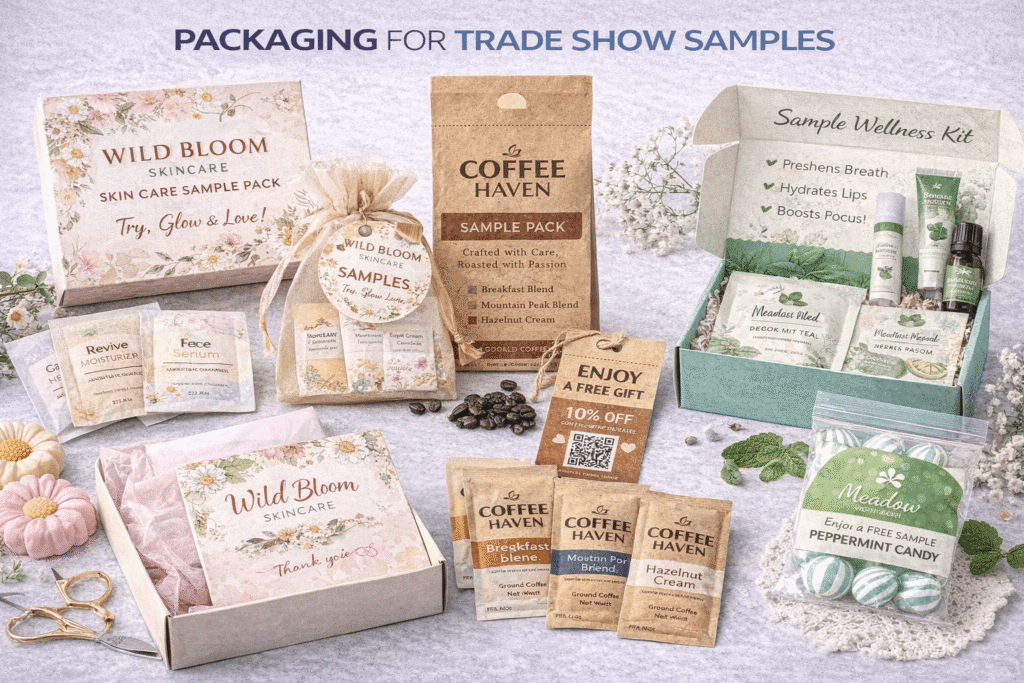
Trade shows are high-noise environments. Hundreds of brands compete for attention within a limited time frame, and attendees make rapid decisions about what to engage with and what to ignore. In this context, trade show sample packaging is not a secondary concern. It is often the deciding factor between a sample being kept, discarded, or forgotten before the event ends.
Samples are only valuable if they survive beyond the booth. Packaging determines whether that happens.
The primary purpose of trade show sample packaging is portability. Attendees collect multiple items, brochures, and business cards throughout the day. Packaging that is bulky, fragile, or awkward to carry becomes a liability. Compact, lightweight packaging that protects the sample without excess performs best in real-world trade show conditions.
Materials That Hold Up on Trade Show Floors
Durability is the next priority. Samples are handled repeatedly, placed into bags, removed, and redistributed. Packaging must withstand friction, pressure, and movement without tearing or opening unintentionally. A sample that leaks, breaks, or degrades during the event reflects poorly on the brand regardless of product quality.
Design clarity matters more than visual complexity. Trade show environments overwhelm attention. Packaging should communicate brand identity instantly. Clear logos, simple colour systems, and legible typography outperform detailed graphics. Attendees rarely stop to read long explanations. Trade show sample packaging should signal recognition, not explanation.
Size discipline is critical. Oversized packaging feels wasteful and discourages retention. Undersized packaging risks damage and looks careless. Right-sized packaging communicates efficiency and competence. When a sample fits its packaging precisely, it signals intention rather than improvisation.
Trade show sample packaging must also support fast distribution. Booth staff often hand out hundreds of samples in short bursts. Packaging that requires explanation, assembly, or careful handling slows interaction and creates friction. Simple formats that can be handed over confidently improve flow and reduce staff fatigue.
Material choice directly affects perception. Thin or flimsy packaging cheapens the product experience. Over-engineered packaging feels disconnected from the purpose of a sample. The goal is balance. Materials should feel intentional and fit-for-purpose without adding unnecessary cost or weight.
Branding restraint is especially important. Trade show samples often end up in shared bags, offices, or homes. Overly promotional packaging discourages reuse and long-term retention. Subtle branding increases the likelihood that packaging survives beyond the event and continues carrying brand presence.
Trade show sample packaging should also support context. Many samples are taken for later evaluation rather than immediate use. Packaging should protect the product and include essential information without requiring additional brochures. A simple label, insert, or printed panel that identifies the product and brand is often sufficient.
Information hierarchy must be disciplined. Product name and brand should be immediately visible. Secondary information such as usage instructions or contact details should be accessible but not dominant. Overloading packaging with copy reduces clarity and increases disposal rates.
For food, cosmetic, or consumable samples, compliance cannot be compromised. Packaging must accommodate required information clearly and legibly. Trade show sample packaging should be designed with regulatory needs in mind from the start rather than retrofitted later.
Sustainability perception plays an increasing role at events. Attendees are more conscious of waste, especially at large-scale exhibitions. Excessive or disposable packaging is noticed and judged. Minimal, recyclable, or reusable packaging aligns better with modern expectations and improves brand credibility.
Multi-use packaging is particularly effective. Sleeves, envelopes, or small boxes that can be reused for storage extend packaging life. Even if the sample is consumed or used quickly, reusable packaging remains. This prolongs brand exposure without additional distribution effort.
Colour choice should consider the event environment. Trade halls often have mixed lighting. High-contrast designs remain legible across conditions. Subtle tonal designs may look refined in studio lighting but disappear in crowded halls. Trade show sample packaging should prioritise visibility without becoming loud.
Cost efficiency must be evaluated strategically. Trade shows require volume. Packaging that looks good at low quantities may not be viable at scale. Designs should support bulk production without compromising quality. Repeatable systems reduce unit cost and simplify reordering for future events.
Consistency across sample types strengthens recognition. Brands often distribute multiple sample variants at the same event. Using a unified packaging system with small variations prevents confusion and reinforces brand cohesion. Fragmented packaging weakens recall.
Labelling and logistics integration should be planned early. Barcodes, batch codes, or tracking elements must fit cleanly without disrupting design. Trade show environments are fast-paced. Clear identification reduces internal confusion and improves distribution accuracy.
Staff interaction is influenced by packaging design. Packaging that looks professional increases confidence in the handover. Staff are more comfortable offering samples that feel deliberate rather than improvised. This affects both volume and quality of interactions.
Post-event behaviour is where packaging value is truly measured. Samples that make it home are often evaluated days or weeks later. Packaging that protects, identifies, and reinforces brand positioning at that moment extends the life of the trade show investment.
Testing should include realistic scenarios. Packaging should be carried in bags, stacked, and handled repeatedly before final approval. This reveals weaknesses that static evaluation misses. Trade show sample packaging must survive movement, not just look good on a table.
Operational simplicity remains essential. Packaging that complicates packing, transport, or booth setup introduces avoidable stress. Simple formats that nest, stack, and transport efficiently support smoother execution and lower costs.
Working with experienced print and packaging partners improves outcomes significantly. Strategic guidance helps brands choose materials, formats, and print methods suited to high-volume, high-pressure event environments. Collaboration with Kawaii Labs Corporate supports this process by aligning brand intent with practical execution and scalability.
Planning timelines should allow for sampling and refinement. Trade show deadlines are fixed. Packaging errors discovered late are difficult to correct. Early planning protects both budget and brand reputation.
Ultimately, trade show sample packaging determines whether a sample fulfils its purpose. The goal is not distribution. It is retention and recall. Samples that disappear into bins deliver no value. Samples that survive, travel, and are remembered justify the investment.
In competitive exhibition environments, brands do not win by giving away more. They win by being remembered. Trade show sample packaging is the silent factor that decides which brands leave the hall and which stay behind in the trash.