
Photo by Kawaii Labs
Printed stickers are often underestimated because of their simplicity. They are small, inexpensive, and easy to produce. Yet when used strategically, printed stickers for brand loyalty become one of the most effective long-term retention tools available. Their power lies not in persuasion, but in participation. Customers choose how and where stickers live, and that choice creates emotional ownership.
Why Printed Stickers Are Powerful Loyalty Tools
Brand loyalty is built through repeated, positive interactions. Stickers support this by extending the brand beyond the initial transaction. Unlike inserts that are read once or packaging that is discarded, stickers invite ongoing engagement. When a customer applies a sticker, they are actively affiliating with the brand. That action matters.
The first principle of using printed stickers for brand loyalty is understanding intent. Stickers should not be treated as advertisements. Overt promotional messaging reduces adoption. The more a sticker feels like marketing, the less likely it is to be used. Loyalty grows when stickers feel like brand expressions rather than brand demands.
Design restraint is essential. Stickers that work best for loyalty are often simple. A strong logo mark, icon, illustration, or pattern outperforms text-heavy designs. Simplicity makes stickers more versatile and increases placement opportunities. The goal is to integrate into personal spaces, not dominate them.
Emotional relevance drives retention. Stickers that reflect shared values, humour, identity, or aesthetic resonate more deeply than generic branding. When customers feel that a sticker represents something about them, they are more likely to keep it. Printed stickers for brand loyalty succeed when they align with how customers see themselves.
Context matters. Stickers included at the right moment carry more meaning. Packaging inserts, thank-you notes, onboarding kits, and loyalty rewards are ideal touchpoints. A sticker received after a positive experience reinforces that emotion. A sticker received without context feels disposable.
Quality plays a decisive role. Cheap stickers undermine trust. Peeling edges, fading ink, or poor adhesion signal a lack of care. Customers hesitate to apply stickers they do not trust to last. Durable vinyl stickers with clean finishes increase confidence and use. Longevity supports loyalty because the brand remains visible over time.
Finish choice affects perception. Matte finishes feel subtle and considered, making them popular for laptops and notebooks. Gloss finishes enhance colour vibrancy and work well for bold designs. The finish should reflect brand tone and expected placement. Consistency across sticker runs strengthens recognition.
Printed stickers for brand loyalty work best when they are optional, not forced. Including one or two stickers rather than overwhelming customers with multiples respects their space. Scarcity can increase perceived value. A sticker that feels intentional is more likely to be used than a pile that feels like filler.
Collectability strengthens loyalty over time. Brands can introduce variations, limited editions, or seasonal designs that encourage repeat engagement. Customers who recognise patterns or series feel rewarded for continued interaction. This approach builds familiarity without requiring discounts or promotions.
Community signaling is another powerful mechanism. Stickers act as social signals. When applied to laptops, bottles, or notebooks, they are seen by others. This creates organic brand exposure driven by trust rather than advertising. Each placement becomes a quiet endorsement.
Printed stickers also support brand recall between purchases. Many loyalty efforts fail because brands disappear after checkout. Stickers remain present in daily environments, keeping the brand top of mind without interruption. This passive visibility supports repeat purchasing naturally.
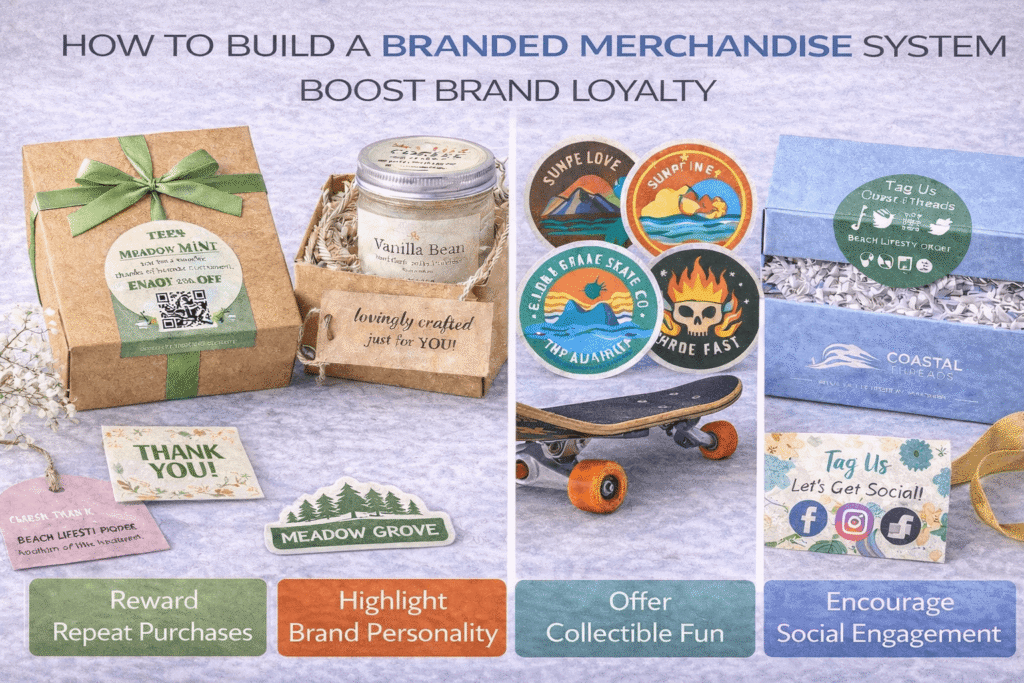
Stickers perform particularly well when paired with other touchpoints. A sticker alongside a thank-you card, care guide, or handwritten note feels cohesive. The combination reinforces that the brand values the relationship, not just the sale. Printed stickers for brand loyalty are most effective as part of a system, not a standalone tactic.
Internal brand loyalty should not be overlooked. Stickers used in employee kits, onboarding packs, or internal campaigns reinforce culture and belonging. Employees who use branded stickers become visible brand advocates. This internal alignment strengthens external perception.
Placement guidance can increase adoption subtly. A small suggestion such as “stick it where you like” or visual cues in marketing content show how stickers might be used without dictating behaviour. The key is invitation, not instruction.
Sustainability considerations influence perception. Customers are increasingly aware of waste. Stickers that are durable and meant to be kept feel more responsible than disposable alternatives. Printed stickers for brand loyalty should prioritise longevity over volume.
Measurement of impact should focus on retention and engagement rather than immediate conversion. Stickers rarely drive direct sales. Their value appears in repeat purchases, social visibility, and brand affinity. Brands that understand this avoid misjudging sticker effectiveness.
Operational simplicity supports consistency. Sticker designs should be easy to reproduce and include across orders without disrupting fulfilment workflows. Complicated variations increase error risk and reduce scalability. Simple systems outperform complex ones over time.
Working with experienced print partners improves outcomes significantly. Strategic guidance ensures that material, finish, and design choices support long-term use rather than short-term novelty. Collaboration with Kawaii Labs Corporate supports this by aligning sticker production with broader branding and retention strategies.
Testing remains important. Brands should observe how customers actually use stickers. Feedback and observation inform refinement. Not every design will resonate equally, and iteration strengthens results.
Ultimately, printed stickers for brand loyalty work because they are chosen. Customers decide whether to keep them, apply them, and display them. That choice is a signal of trust.
Loyalty is not built through loud messaging. It is built through repeated, positive signals that respect the customer. Printed stickers, when used with intention, create those signals quietly and persistently.
In a crowded market, brands that are invited into personal spaces earn a different level of connection. Printed stickers that feel thoughtful, durable, and aligned turn everyday surfaces into long-term brand touchpoints. That is how loyalty grows, one small decision at a time.