Photo by Pexels
Why Printed Lead Collection Still Works at Events
In an era dominated by QR codes, badge scanners, and event apps, printed lead collection cards and forms may seem outdated. In reality, they remain one of the most reliable and effective tools for capturing leads at events. Their strength lies in simplicity, accessibility, and control.
Not every event has reliable connectivity. Not every attendee wants to scan a code, download an app, or type personal information into a shared device. Printed forms remove these barriers instantly. They work anywhere, require no explanation, and feel neutral rather than invasive.
Printed lead collection also changes the psychology of the interaction. When an attendee takes a pen and writes information, the interaction slows down slightly. That pause increases engagement and intention. Instead of rushing through digital fields, attendees think about what they are sharing. This often results in more accurate and meaningful data.
At Kawaii Labs Corporate, lead collection cards are treated as operational tools, not design afterthoughts. Their purpose is clear: capture usable data efficiently while supporting the overall event experience.
The Difference Between Collecting Leads and Collecting Useful Leads
One of the biggest mistakes brands make at events is focusing on volume instead of quality. A long list of incomplete, incorrect, or unqualified leads wastes time and resources after the event. Well-designed lead collection cards and forms prioritise usefulness over quantity.
Every field on a form should earn its place. If information will not be used during follow-up, it should not be requested. Shorter forms consistently outperform longer ones because they reduce friction and fatigue.
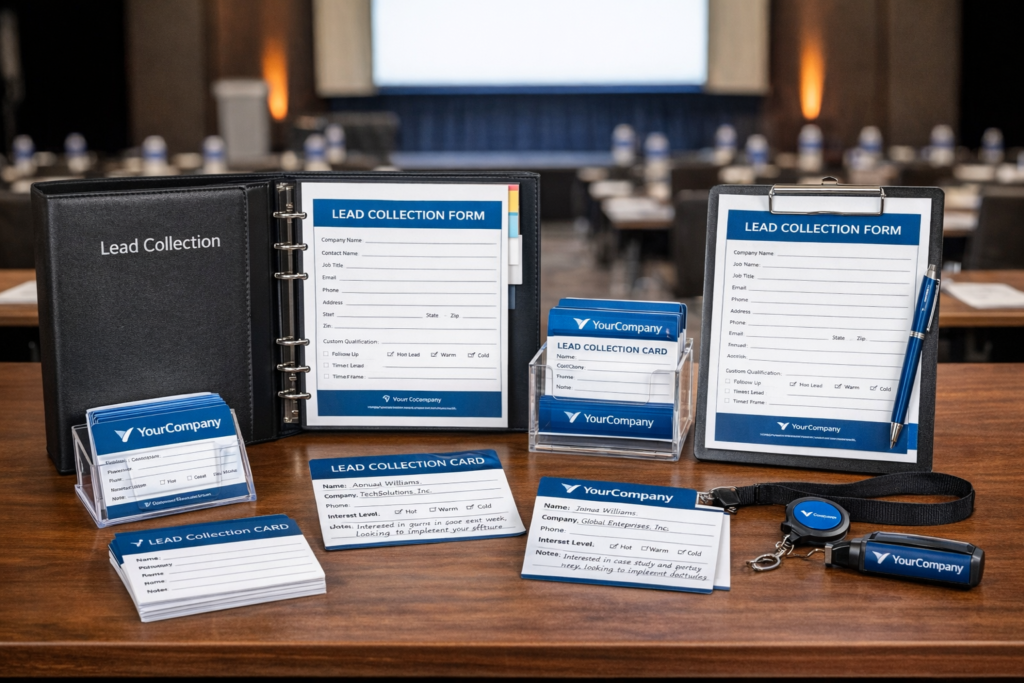
In most cases, the most effective forms include:
- Name
- Email address
- Company name
- One qualifying question
That qualifying question is critical. It might identify buying intent, timeframe, budget range, or specific interests. This single data point allows teams to prioritise follow-up intelligently rather than treating every lead the same.
Designing Lead Collection Cards That Get Completed
Design is not about decoration in lead collection. It is about usability. Layout choices directly affect completion rates.
Spacing matters. Fields must be large enough to write in comfortably. Crowded forms frustrate users and result in illegible handwriting. White space improves readability and reduces cognitive load.
Typography should be simple and highly legible. Avoid thin fonts or low-contrast colours. Labels must be clear and unambiguous. If attendees have to ask questions about how to fill out a form, the design has failed.
Paper stock also plays a role. Flimsy paper bends and shifts while writing, making the process uncomfortable. Slightly heavier stock provides stability and feels more professional. It also signals that the brand values the interaction.
Branding should be restrained. A logo and subtle colour accents are enough. Over-branding turns the form into a promotional piece, which can reduce completion rates. The primary job of the card is data capture, not marketing.
Placement and Usage at the Booth
How lead collection cards are used matters just as much as how they are designed. Leaving a stack of cards unattended often results in poor-quality data or no data at all. Printed forms work best when paired with human interaction.
Booth staff should introduce the form naturally during conversation, not as an obligation. Explaining why information is being collected builds trust. For example, framing the form as a way to receive follow-up resources or personalised information improves willingness to complete it.
Designated collection areas help keep forms organised and secure. Clipboards, trays, or folders prevent loss and confusion during busy periods. Clear internal processes ensure completed forms are not misplaced or damaged.
Turning Paper Leads Into Action After the Event
The effectiveness of printed lead collection depends heavily on what happens after the event. Without a clear post-event process, even well-designed forms lose value.
Responsibility for lead handling should be assigned before the event begins. This includes collection, digitisation, and follow-up. Delays reduce conversion rates significantly. Ideally, leads should be entered into a CRM system within 24 to 48 hours.
Digitisation accuracy matters. Handwritten data must be transcribed carefully. Poor transcription undermines the advantages of thoughtful form design. Some brands choose to scan completed cards as backups, adding an extra layer of security.
Follow-up messaging should reference the event interaction whenever possible. This continuity reinforces relevance and increases response rates. Printed lead cards support this by capturing context that digital scans often miss.
Integrating Printed Forms With Digital Systems
Printed lead collection does not exclude digital systems. In fact, the two work best together. Forms can include QR codes that link to additional resources or confirmation pages. This allows attendees to engage digitally after the initial interaction.
Some brands use printed forms as a fallback or parallel system alongside digital tools. This ensures no opportunities are lost due to technical issues, low battery devices, or attendee reluctance.
At Kawaii Labs Corporate, we often recommend printed lead cards as part of a hybrid approach. They provide reliability while still supporting modern follow-up workflows.
Why Lead Collection Cards Remain a Smart Event Investment
Lead collection cards and forms succeed because they are practical. They respect attendee preferences, reduce friction, and give brands control over data quality. They do not rely on technology behaving perfectly in unpredictable environments.
When designed intentionally and supported by clear processes, printed lead collection delivers strong ROI. It captures meaningful information, supports efficient follow-up, and integrates seamlessly into broader event strategies.
Printed lead collection is not a step backward. It is a grounded, proven method that continues to perform in real-world event conditions.


